
What height retaining wall needs engineering in Tasmania?

In Tasmania, retaining walls over 1 metre in height require engineering certification and council approval, particularly when located near property boundaries or retaining significant ground loads. Hobart City Council mandates approval for walls exceeding 1m near boundaries, while height thresholds vary slightly across other Tasmanian councils.
Engineering Requirements by Height:
- Under 1m: May not require formal engineering (site-specific assessment recommended)
- 1m to 1.5m: Engineering certification required
- Over 1.5m: Full structural engineering documentation needed
Walls approaching 800mm should still involve professional design consultation due to potential structural failure risks affecting safety and neighbouring properties. All retaining walls must comply with AS 4678 (Earth Retaining Structures) standards. Always verify specific requirements with your local council’s planning scheme, as regulations consider factors including boundary proximity, soil conditions, and surcharge loads.

Types of Concrete Retaining Walls for Hobart Properties
| Wall Type | Typical Height Range | Best Applications | Key Benefits |
|---|---|---|---|
| Gravity Walls | Up to 1.5m | Garden beds, minor slopes | Cost-effective, simple design |
| Cantilever Walls | 1-3m | Residential slopes, driveways | Material efficient, space-saving |
| Sleeper/Block Walls | Up to 2m | Terraced gardens, landscaping | Modular, design flexibility |
| Monolithic Walls | 2m+ | Heavy loads, high walls | Maximum strength, long lifespan |
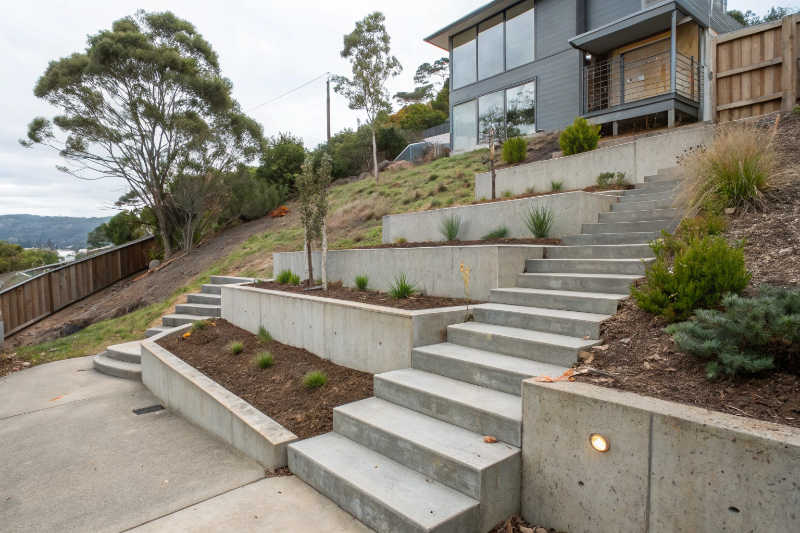
Managing Hobart's Sloping Terrain and Site Challenges
Common Applications Across Greater Hobart: Creating level terraced areas in Mount Nelson, West Hobart, and Sandy Bay. Driveway access and level changes on hillside properties. Pool surrounds and outdoor entertainment areas on slopes require safe, functional spaces.
Hobart-Specific Site Considerations: Sloping blocks are common throughout hillside suburbs. We assess soil types – clay, sand, and rock composition. Water table in wet valleys, coastal salt exposure in Battery Point and Sandy Bay areas matter.
Soil and Drainage Assessment: Professional geotechnical evaluation identifies soil load-bearing capacity and drainage patterns. We check site access for equipment and concrete delivery trucks. Water management planning prevents future structural issues and land movement.

Engineering Requirements and Council Approval Process
Structural Engineering Certification: Engineering is legally required for walls over 1m in height. Calculations include soil pressure, surcharge loads, and lateral forces. Foundation footings need proper depth, reinforcement uses N12 or N16 steel bars typically.
Hobart City Council Approval Process: Planning permits take 4-8 weeks, typically. Boundary setback regulations apply, and neighbouring properties get notified. AS 4678 compliance documentation goes to building surveyors. The process protects everyone’s property and safety long-term.
Working with Certified Engineers: Local Tasmanian engineering expertise matters for Hobart’s specific conditions. Engineers provide structural calculations and documentation for council submission. Site-specific design accounts for our soil types, rainfall patterns, and frost action during winter months.
Construction Process and Project Timeline
1. Site Assessment and Engineering. We survey your property and get engineering certification for walls over 1m. Council approval comes next, taking 4-8 weeks typically.
2. Excavation and Foundation Excavation creates space for footings. We pour concrete footings and let them cure for 3-7 days before moving forward.
3. Formwork and Reinforcement Formwork gets installed and aligned precisely. Steel reinforcement bars (N12 or N16) are placed and tied according to engineering specifications.
4. Concrete Pour and Drainage Concrete gets poured in single or multiple lifts, depending on wall height. Drainage pipes and weep holes are installed during backfilling.
5. Finishing and Landscaping After curing, formwork comes off. We backfill with free-draining aggregate and integrate landscaping to complete your retaining wall project.
Frequently Asked Questions About Concrete Retaining Walls in Hobart
How much does a concrete retaining wall cost in Hobart?
Costs vary based on wall height, soil conditions, and site access. Small gravity walls under 1m might run $300-500 per linear metre, while engineered cantilever walls over 2m can reach $800-1,200+ per metre. We provide free quotes after assessing your specific property because every sloping block in Hobart has different requirements.
Do I need council approval for my retaining wall?
If your wall is over 1m high or sits near a boundary, yes, you’ll need Hobart City Council approval. Walls under 1m might not need formal permits, but we always recommend checking first. The approval process takes 4-8 weeks, and we can help you through the paperwork and engineering documentation.
How long will my concrete retaining wall last?
A properly built concrete retaining wall with good drainage should last 40+ years in Hobart’s climate. We’ve seen walls fail in 10-15 years when drainage wasn’t done right, but with agricultural pipe, weep holes, and free-draining backfill, your wall will handle Tasmania’s rainfall for decades.
What's the best type of retaining wall for my sloping property?
That depends on your wall height and what you’re trying to achieve. For garden beds under 1.5m, gravity walls work great and cost less. Between 1-3m, cantilever walls are your best bet – they’re engineered, space-efficient, and handle Hobart’s slopes well. We’ll recommend the right type after seeing your site.
Can I build a retaining wall myself?
Legally, you can build walls under 1m yourself in some cases, but we don’t recommend it. Even small walls need proper footings, drainage, and backfill to survive Hobart’s rainfall. Get the drainage wrong, and you’re looking at expensive repairs. Anything over 1m requires engineering and council approval anyway.
How important is drainage for retaining walls in Hobart?
Drainage is everything. Hobart gets 600mm+ of rain annually, and water pressure behind a wall will destroy it if there’s nowhere for that water to go. We install agricultural pipe, weep holes every 1-2m, and free-draining gravel backfill on every job. Skip the drainage, and your wall won’t last.
