
Types of Concrete Footings We Install

Different structures need different footings — and Hobart’s varied terrain means we use just about every type you can think of.
Strip footings run continuously under your load-bearing walls. They’re the backbone of most homes and extensions, spreading the weight evenly along the entire wall line. You’ll see these on new builds and major additions across Hobart.
Pad footings are individual concrete bases that support posts and columns. Think of them as solid anchors for your deck posts, pergola supports, or verandah columns. They’re compact but incredibly strong when sized correctly.
For slabs that need extra stability, raft footings combine your floor slab with integrated edge beams. They work well on reactive soils and are becoming more common in Hobart’s newer developments.
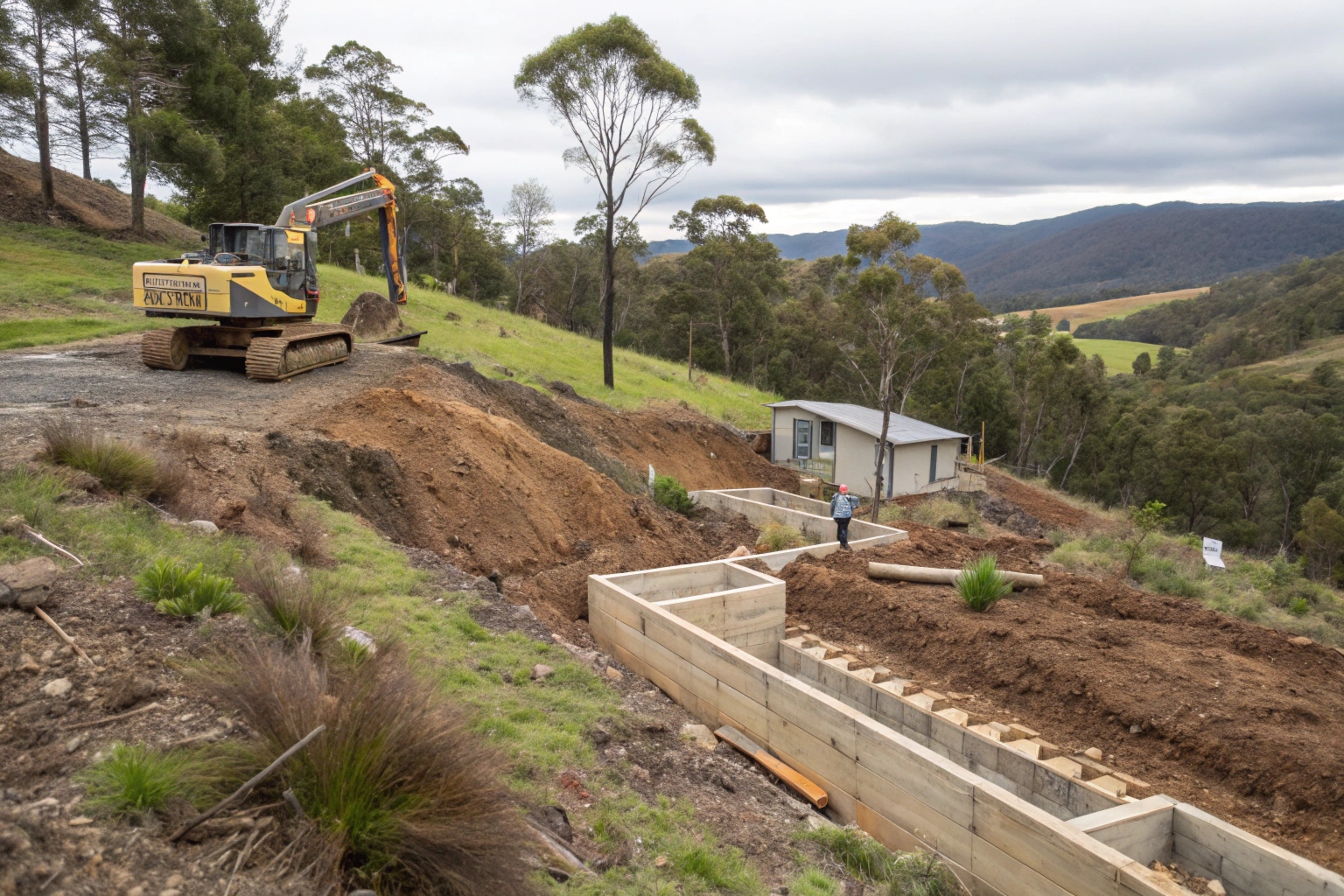
Pier footings go deep into the ground, which makes them perfect for Hobart’s sloping sites. If you’re building on a hillside property in areas like Mount Nelson or Dynnyrne, you’ll probably need these. They reach down to stable soil or rock below the surface layers.
Stump footings support raised timber floors. Plenty of older Hobart homes sit on stumps, and when you’re replacing them or building something similar, proper concrete footings under each stump are what keep everything level and stable.
Retaining wall footings need to handle serious loads — they’re supporting walls that hold back tonnes of soil. Get these wrong and your retaining wall won’t last. Fence post footings are smaller but still important for secure fencing that’ll handle Hobart’s winds.

What We Pour Footings For
Concrete footings in Hobart aren’t just for new houses — though we do plenty of those. The range of projects we work on shows just how important proper footings are for all sorts of structures.
New home construction is where footings matter most. Your entire house sits on them, and they need to meet engineering specs and council requirements. We work with builders and owner-builders right across Hobart to get foundations started right.
Home extensions need footings that match your existing structure but also stand on their own. Whether you’re adding a bedroom, extending the kitchen, or building out the back, those new footings have to integrate properly with what’s already there.
Planning a second storey? Those footings are taking on a whole lot more weight than they were originally designed for. We work with structural engineers to make sure your existing footings can handle it — or design new ones if needed.
Garages and sheds still need solid footings even though they’re not living spaces. A concrete slab sitting on proper strip or pad footings will outlast a slab poured straight on the ground every time.
Decks and pergolas rely on pad footings under each post. Hobart’s weather — the wind, the rain, the occasional snow — means your outdoor structures need to be anchored properly.
Retaining walls are massive in Hobart because of all our sloping blocks. The footing is what stops your retaining wall from tipping, sliding, or cracking under all that soil pressure.
Even carports and verandahs need footing work for their support posts. It’s not glamorous, but it’s what keeps your roof overhead where it belongs.

Why Hobart Footings Are Different
Building in Hobart isn’t the same as building in Sydney or Melbourne — our ground, our slopes, and our weather all play a part in how footings need to be done.
Soil testing comes first, always. Hobart’s got clay in some spots, sandy soils in others, and plenty of rock once you get digging. What you find in Lenah Valley might be completely different from what’s under a block in Bellerive. We test before we dig because the soil type determines everything else.
Tasmania’s soil can be reactive — meaning it swells when wet and shrinks when dry. That movement puts stress on footings, which is why we size them properly and use the right reinforcement.
Most Hobart blocks have some slope to them. Flat blocks are rare, and that means footings often need to be stepped or we’re using piers to get down to solid ground. Suburbs like Mount Nelson, West Hobart, and Sandy Bay are full of sloping sites where standard footings just won’t work.
Frost depth matters here too. We go at least 300mm down to get below the frost line. Any shallower and you risk frost heave pushing your footings around during winter.
Groundwater and drainage can’t be ignored. Hobart gets plenty of rain, and water sitting around footings causes problems. We make sure drainage is sorted so water moves away from your foundations, not towards them.
Every footing we pour follows engineering specifications written for Hobart’s conditions. Your engineer looks at soil reports, slope, loading, and local factors to design footings that’ll actually work for your specific site.
Getting the Specs Right
Concrete footings aren’t something you eyeball and guess at — there’s real engineering behind every measurement.
Depth depends entirely on what your soil test shows. Clay soils might need footings 600mm deep or more, while stable ground might only need 300-400mm. Your engineer calculates this based on soil bearing capacity and what’s being built above.
Width and bearing capacity work together. A footing needs to be wide enough to spread the building’s load across enough soil so nothing sinks or settles. Strip footings in Hobart typically run 450-600mm wide, but sloping sites or poor soil can push that wider.
Reinforcement is what gives footings their strength. We’re usually installing N12 or N16 steel bars, positioned and tied properly so they actually do their job. The bars need correct spacing and proper concrete cover to prevent rust.
Concrete strength for footings is typically N20 or N25 grade minimum. This isn’t the stuff you mix in a wheelbarrow — it’s structural concrete that meets Australian standards and lasts decades.
How footings connect to the structure above matters too. Wall plates, anchor bolts, or starter bars all need to be positioned accurately during the pour. Get that wrong and your builder has problems later.
Load distribution is the whole point. Footings take concentrated loads from walls and posts and spread them out over a bigger area of soil. That’s engineering at work.
For anything more than a basic shed, you’ll need engineer certification. Council wants to see signed-off plans before you start digging.
Compliance & Building Standards
Building footings in Hobart means following Tasmania’s building codes and Australian standards — no shortcuts, no guessing.
Tasmanian building code compliance isn’t optional. Every footing we pour meets the current Building Code of Australia as it applies in Tasmania. Council inspectors check this stuff, and if it’s not right, you’re not moving forward with your build.
AS 2870 is the Australian Standard for residential slabs and footings. It covers everything from soil classification to footing design for houses and similar structures. If you’re building a home or extension in Hobart, your footings need to comply with AS 2870.
For larger or more complex structures, AS 3600 applies — that’s the concrete structures standard. Commercial buildings, big retainers, anything engineered needs to meet these specs.
Hobart City Council has its own building approval process. You’ll need engineered plans, soil reports, and footing designs submitted before you get approval to start. Some suburbs have additional requirements depending on bushfire risk or heritage overlays.
Engineering plans and certification are required for most footing work. Your structural engineer designs the footings, signs off on the plans, and usually inspects during construction to certify everything’s been built as designed.
Inspector sign-off happens at key stages. Council building inspectors want to see footings before concrete gets poured, and again before you backfill. Miss an inspection and you might be digging footings back out to prove they’re right.
Bushfire Attack Level considerations apply in some Hobart areas. Higher BAL ratings mean footings might need additional design elements to meet fire safety requirements.
FAQs About Concrete Footings
Minimum 300mm to get below the frost line, but most footings go 450-600mm depending on soil type and what you’re building. Sloping sites or poor soil can need deeper footings. Your engineer specifies the exact depth after looking at soil tests.
For anything more than a basic fence or small shed, yes. Houses, extensions, retaining walls, and structures with engineering loads all need engineered footing designs. Council won’t approve your build without them.
Concrete needs at least 2-3 days before you’re building on it, sometimes longer depending on weather and concrete strength requirements. We don’t rush this — proper curing means footings that last.
Depends entirely on your project. Engineering, soil testing, excavation difficulty, how much reinforcement, concrete volume, and site access all affect pricing. Sloping sites cost more because of the extra work involved. Get a proper quote based on your actual plans.
Yes, but we need to manage it properly. Cold temperatures slow concrete curing, and we can’t pour if frost or heavy rain is forecast. Winter jobs take a bit more planning.
Absolutely. Stepped footings or pier systems are standard on Hobart’s hills. Your engineer designs footings that account for the slope and prevent movement.
Ready to Start Your Hobart Project?
Footings are the foundation of everything you’re building — and getting them right means your project starts on solid ground.
Whether you’re planning a new home in Kingston, adding an extension in Glenorchy, or dealing with a sloping block in Mount Nelson, proper concrete footings designed for Hobart’s conditions are what you need. We work with your engineer, follow Tasmania’s building codes, and we know what it takes to get council approval the first time.
No guessing, no shortcuts — just footings poured to spec that’ll support your structure for decades. We handle everything from soil testing coordination through to the final pour and inspector sign-off.
Got plans ready to go? Still figuring out what your project needs? Either way, let’s talk about your footings. We’ll walk you through what’s required for your specific site, what the process looks like, and get you accurate pricing based on your actual project.
Your build deserves foundations you can trust. Get in touch and let’s get your footings sorted.
