
Concrete Breaking Across Greater Hobart's Unique Properties

We’ve been handling concrete breaking projects across Greater Hobart for years now, and if there’s one thing we’ve learned, it’s that every property presents its own challenges. From the narrow side access common in Sandy Bay to the sloping blocks up in Mount Nelson, from heritage area restrictions in Battery Point to the salt-damaged concrete near the waterfront – we’ve tackled them all.
We provide complete concrete breaking services throughout Hobart and surrounding areas, handling everything from small pathway removals to large-scale commercial demolition projects. Our approach combines professional-grade equipment – from excavator-mounted hydraulic breakers to precision concrete saws – with the kind of local experience that comes from years of working on Hobart properties.

Types of Concrete Breaking Services We Provide
Breaking Methods and Equipment We Use
Hydraulic Breakers on Excavators
For larger concrete breaking projects in Hobart, hydraulic breakers mounted on excavators are the most efficient solution. These machines deliver massive breaking force while allowing us to work quickly through thick concrete, heavily reinforced slabs, and large areas. We match excavator size to your site – from compact 5-tonne machines for residential driveways.
Jackhammer Breaking
Handheld jackhammers – both pneumatic and electric – are perfect for medium-sized jobs and areas where excavator access isn’t possible. They’re what we use for side pathways, small patio areas, confined spaces, and precision work around structures. Electric jackhammers are quieter and ideal for noise-sensitive areas in established neighborhoods.
Core Drilling for Breaking
Core drilling creates weak points in thick concrete, making breaking easier and more controlled. This technique is particularly useful for very thick slabs, heavily reinforced concrete, and situations where we need to break the concrete without excessive vibration that might affect nearby structures.
Concrete Saw Cutting
Sometimes controlled cutting comes before breaking. We use concrete saws for precision sectioning, creating straight edges, cutting around services you want to keep, and dividing large slabs into manageable sections. Wet cutting keeps dust down and extends blade life while giving us clean, accurate cuts.
Core Drilling for Breaking
Core drilling creates weak points in thick concrete, making breaking easier and more controlled. This technique is particularly useful for very thick slabs, heavily reinforced concrete, and situations where we need to break the concrete without excessive vibration that might affect nearby structures.
Rock Breaker Attachments
For the really heavy-duty demolition work – think thick industrial floors, heavily reinforced commercial slabs, or old bridge approaches – rock breakers deliver the power needed. These attachments turn our excavators into serious demolition machines capable of breaking through just about anything.

The Equipment and Machinery We Use
20-Tonne Excavators: Handle large commercial slabs quickly.
5-8 Tonne Excavators: Ideal for standard residential driveways and patios.
Bobcats with Breakers: Perfect for medium jobs with limited access.
Electric Jackhammers: Work in tight, noise-sensitive areas.
Pneumatic Breakers: High-power handheld demolition for thick concrete.
Wet-Cutting Concrete Saws: Precise cutting with dust suppression and reinforcement handling.
Tip Trucks: Efficient concrete removal for residential and commercial projects.
Maintenance: All equipment is regularly serviced for reliability and on-time job completion.
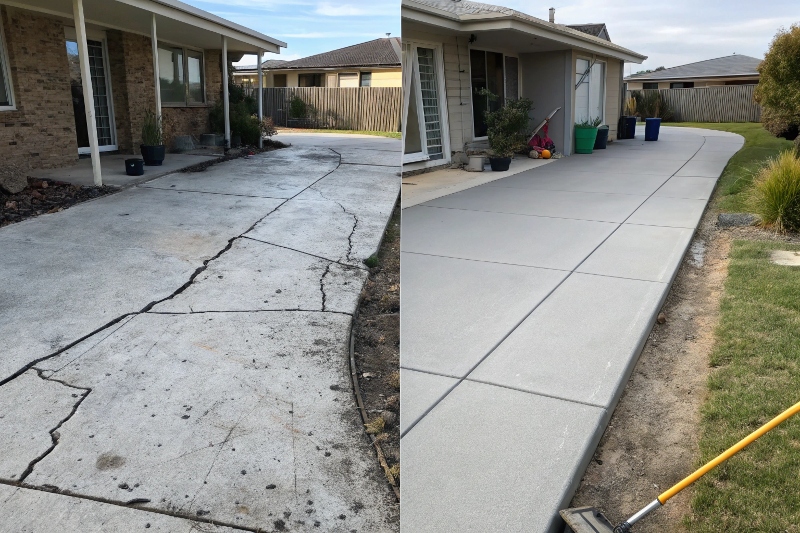
How We Assess Your Concrete Breaking Project
Concrete Thickness: Determines breaking time, equipment, and waste volume.
Reinforcement Type: Mesh, rebar, or plain concrete affects difficulty and methods.
Underground Services: Locate water, gas, electrical, and communication lines to avoid damage.
Equipment Access: Assesses property access to select suitable machinery and methods.
Breaking Method: Chosen based on thickness, reinforcement, access, and efficiency.
Waste Volume: Calculated to plan truck loads and disposal costs.
Timeline & Scheduling: Depends on job size, access, and weather considerations.
Council Permits: Most residential jobs don’t require permits, but exceptions exist; guidance provided when needed.
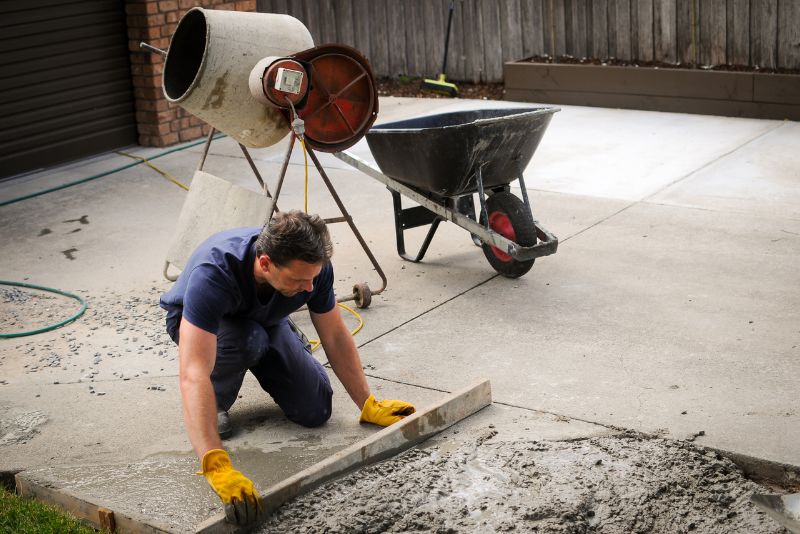
Safety and Service Protection
Underground Utility Location: Dial Before You Dig and detection equipment are used to locate all underground services before breaking.
Water, Gas, and Electrical Protection: Services are marked to prevent flooding, gas hazards, or electrical outages.
NBN and Communication Cables: Shallow cables are identified and protected to maintain internet and phone connections.
Stormwater and Drainage Systems: Careful work around drains and pipes prevents flooding and costly repairs.
Protective Barriers and Safety Zones: Work areas are cordoned off with signage to protect people and pets; commercial sites follow site-specific safety requirements.
Dust Suppression Measures: Water sprays control dust during breaking and cutting, minimizing neighborhood disruption.
Noise Management Strategies: Work is done within council-approved hours, using the quietest effective equipment, with neighbors notified in sensitive areas.
Professional Liability Insurance: Full public liability insurance ensures protection for property damage or unforeseen incidents
Partial Breaking and Repair Solutions
Selective Concrete Removal: Only damaged areas are removed, preserving surrounding sound concrete.
Creating Openings for Services: Concrete is broken just enough for plumbing, drainage, or other service installation, then patched afterward.
Removing Damaged Sections Only: Problem areas like cracked driveways or sunken patios are targeted, saving money and materials.
Preparing for Patch Repairs: Cleanly broken edges make patching more effective and improve the final result.
Access Holes for Plumbing Work: Concrete is removed precisely to allow plumber access for repairs or installations.
Precision Breaking Around Structures: Saw cutting and careful techniques protect nearby structures and existing features.
Preparing Sites for New Concrete
Complete Removal to Required Depth: Old concrete is fully removed to the necessary depth for the new project.
Exposing and Checking Base Material: Base is assessed for compaction, erosion, or replacement needs.
Leveling and Grading Preparation: Rough leveling and grading are done to ensure proper drainage and site levels.
Drainage Evaluation and Improvement: Removal allows addressing water pooling and improving drainage before new concrete.
Service Marking and Identification: Exposed services are marked to prevent damage during installation.
Compaction of Existing Base: Sound base material is re-compacted to support new concrete performance.
FAQs About Concrete Breaking in Hobart
Can you break concrete during Hobart's winter months?
Yes, we work year-round in Hobart, including winter. Cold weather doesn’t stop concrete breaking work – if anything, firmer ground conditions can make site access easier than during wet spring months. The main limitation is heavy rain making sites too muddy to work safely, but we monitor forecasts and schedule around weather windows. Winter projects often have the advantage of fewer flies and less dust spread, which your neighbors will appreciate.
Do I need to be home while you're breaking the concrete?
No, you don’t need to be home during the concrete breaking work. Once we’ve done the site assessment and you’ve approved the quote, we can complete the breaking work while you’re at work or away. We just need access to the area we’re working on – whether that’s through an unlocked side gate or the driveway. Many Hobart homeowners prefer this approach since concrete breaking is noisy and dusty, and being out for the day makes it easier.
What if you find asbestos under my concrete?
If we encounter asbestos during concrete breaking – and it does happen in older Hobart properties – we stop work immediately and bring in licensed asbestos removalists. Asbestos was commonly used in building materials up until the 1980s, so properties in established suburbs like Sandy Bay or Battery Point sometimes have asbestos sheeting or fibro under concrete slabs. The asbestos removal gets handled first by specialists, then we complete the concrete breaking work safely.
Can you break concrete right up against my house foundation?
Yes, but we work carefully when breaking concrete against house foundations. We use smaller equipment and controlled breaking techniques to avoid vibration damage to your foundation or brickwork. This situation is common in Hobart where concrete patios or paths often butt right up against the house. We’ll assess the foundation type during quoting and let you know if there’s any special considerations for your specific situation.
Will the vibration from breaking damage anything inside my house?
Modern concrete breaking equipment creates surprisingly localized vibration, and damage to houses from professional concrete breaking is extremely rare. We’re breaking the concrete in your driveway or yard, not the foundation your house sits on, so vibration dampens quickly through the ground. That said, if you’ve got a really old Hobart home with plaster walls in poor condition, or you’re particularly concerned about antiques or delicate items, it’s worth mentioning during our assessment.
Can you break and remove just the top layer of concrete?
Breaking off just the top layer of concrete – like removing a thin overlay or topping – is possible but tricky. It depends on how well the layers are bonded and whether there’s a clear separation point. In Hobart, we sometimes see properties where a thin decorative layer was added over original concrete, and these can sometimes be removed separately. However, if layers are well-bonded, trying to remove just the top often damages the bottom layer anyway, making full removal more practical.
